Wednesday, August 31, 2011

Phnom Penh: Killing Fields, The

*Disclaimer: Extreme content ahead...입니다.*

If Siem Reap was beauty, then Phnom Penh was emotion. We took an overnight bus from Siem Reap to Phnom Penh and arrived in the early morning before anything was really open...except for what we wanted to see, which apparently opened at 5:30 AM. We rented a tuktuk for the day (from a guy not nearly as cool as Homeboy) and headed through Phnom Penh to our first destination.

Driving through the two cities offered a slightly different experience. Phnom Penh was obviously bigger, being the capital and largest city in Cambodia. The amount of tuktuks and scooters stayed constant, but things were more urban in general and there was wealth present in certain areas. We saw a Lamborghini and a Bentley driving nonchalantly down the street.

Our first stop was Tuol Sleng Prison, or S-21. For those who need the history lesson: On April 17th, 1975, after a seven year civil war, the ultra-Communist Khmer Rouge captured Phnom Penh and solidified their control over Cambodia. They renamed the country Democratic Kampuchea and forced everyone to evacuate the cities for a new era of agrarianism. Year Zero. They abolished hospitals, schools, books, even currency, and forced everyone to work on collective farms as equals. Those who were thought to be intellectuals (identified by things as arbitrary as wearing glasses) were murdered. Members and supporters of the former government were murdered. Non-Cambodian ethnic groups were murdered. Those who for some reason or another had "pre-revolution nostalgia" were murdered. Anyone who could not produce adequate agricultural skills were murdered. They eventually turned on their own and murdered high ranking Khmer Rouge officials. Nobody was safe. Even if they couldn't find a reason to murder, they tortured until the person confessed a crime and named some friends or family members who would then be subsequently arrested.
One of the places in which they were tortured and murdered was Tuol Sleng. After Phnom Penh was evacuated and schools abolished, this high school was turned into a prison/torture center. 17,000 people passed through its gates. Only seven survived. When the Vietnamese invaded and overthrew the Khmer Rouge in 1979, they found Tuol Sleng with 14 bodies quickly killed on the torture tables by the fleeing enemy. The next year, they opened up Tuol Sleng as a museum and kept it very similar to how it looked when they found it. There were even still blood stains on the floor.To say it was powerful would be an understatement. Walking into a room with a bed frame and a picture above it depicting the dead person the Vietnamese found in that very same room, in that very same bed frame was definitely moving. It's hard to describe everything one sees there. The tiny cells. The torture devices. The chains. The bloodstains. The thousands of pictures of victims who passed through the prison's gates, never to be seen or heard from again. Some were children under five. Tortured and murdered all the same. There were rooms full of these photographs.It took less than a year for the grounds surrounding Tuol Sleng to fill up with bodies, so the Khmer Rouge began shipping prisoners out to places like Choeung Ek (our next stop) to be disposed of. Once a Chinese cemetery, the Khmer Rouge turned Choeung Ek into a killing field and mass grave site. After prisoners signed a confession or named the required names of other traitors, they were put in a truck and hauled out to the fields with about 20 or 30 other people, where they were led to a pit and struck with a pick ax or a hoe or any other lethal farm equipment that could kill while saving bullets. Children who were small enough were taken by the legs and swung headfirst into a tree. The specific tree was labeled as we strolled around.

In the center is a memorial to the thousands of bodies they found at Choeung Ek housing the bones of exhumed victims. It's rather startling as the bones are exposed for viewers. Also, while walking around, signs inform you that when it rains they still find things in the soil and don't be surprised if you do too. It's hard to ignore rags half buried in the dirt or more than one random tooth on the ground.

But, with that our depressing tour of Cambodian history was over. We were left with the rest of the day to enjoy more cheery sites like the Cambodian Royal Palace:
Modeled after the Thai Royal Palace.
The Silver Pagoda:
Apparently bird paradise.

The Vietnam/Cambodia Friendship Monument:The Independence Monument:
As featured on their currency!

The Central Market:
The North Korean Embassy:
No, we didn't get to go into the North Korean Embassy, but they did have some funny propaganda on the outside of it--in English.

The Riverfront:
(picture not included)

The Riverfront was charming enough, with that same French style architecture so prominent in Siem Reap. Although instead of $.50 beers like in Siem Reap, the cheapest we could find was $.60 beers (God! Everything is so marked up in the big city!).

Perhaps it was the dust entering through my eyes, nose, and mouth and subsequently clouding my brain, but Phnom Penh had a separate charm than Siem Reap. I didn't want to leave the prices, the currency, the tuktuks, the people, the haggling, the architecture, the atmosphere, the food...

Both Thailand and Cambodia are places I'd visit again, but I'd switch it around and spend more time in Cambodia than Thailand in the future. Cambodia has beach resorts, too...

Tuesday, August 30, 2011

Siem Reap: Tomb Raidin'

I'm not sure if I was fully prepared for Cambodia. Or, I was prepared for something a little different. To be frank, Cambodia was the better part of the trip. Bangkok was a semi-first world metropolis, Ko Phi Phi was a tropical resort island. Cambodia was what I expected Thailand to be more like before the trip started. The second land border I've ever crossed, it was plain to see the difference in economy immediately. We crossed in the morning, paddling upstream against a sea of people crossing into Thailand to go to work. Surely the conditions were better and the pay was higher in Thailand.

The three hour drive to Siem Reap from the border was equally eye opening. We passed through one small town between our start and end point, otherwise it was all country, littered with occasional houses and random shops. I was the only one (besides our driver) who stayed awake for the journey, and I was rewarded with a glimpse of real Cambodia. I will never again see so many naked Cambodian children playing carelessly. I tried to imagine living in a house like that. One room, no electricity, open to the elements, perhaps just a hammock or a cot to sleep on, and only a scooter for transportation. The more I thought I could somehow do it, the more I thought about how my humble home would need a flat screen TV and a PS3. Plenty of beer. Imported wine. With that, the thought that I could manage in a life like this vanished when my first world needs came back to me.

Siem Reap was more charming than any part of Thailand I visited (not to say that parts of Thailand aren't charming. Just not the parts I visited). I think this was because of the French influence on architecture and the general feel of the city. Like a lawless version of New Orleans, I honestly felt like I was in an old Western much of the time. Dirt roads, (motorized) horses and carriages, and second or third floor railings. It was just what I wanted. It also helped that our tuktuk driver, nicknamed Homeboy, was honest and nice. It was strange how a tourist city built on Angkor's back could feel so genuine.

I had looked forward to seeing Angkor Wat for years. It had been on my "bucket list" so to speak, and it seemed to have a time limit. As popularity for the site grows, it will surely lose part of its appeal and cleanliness (a-la Thailand...). I can't stress how large the Angkor Park complex is. At one time, Angkor was the size of modern day Los Angeles, making it by far the largest pre-Industrial Era city by landmass in history. Today, there are still over a thousand identified temples and structures.

Some highlights:Of course, Angkor Wat, the largest religious building in the world and the most recognized temple among the Angkor ruins (naturally undergoing renovations when I get to see it).
Ta Phrom. This one is interesting because it is the only temple on the main circle of temples that is maintained like the other temples used to be before the French restored them: covered in jungle. It's actually a delicate balance because UNESCO wants to keep it meshed with jungle, yet doesn't want the jungle to overtake the structures to the point of destroying their integrity. Thus, there is usually some renovation construction going on here. Also, this temple is the place where part of the movie Tomb Raider was filmed, and also the reason why Angelina Jolie adopted a Cambodian baby. I probably would too, if I were rich. They're so cute.
Bayon in Angkor Thom. This structure was the most visually stunning and the one with the most incredible story. When the French discovered Angkor, they made a point to put the rubble back together as much as they could so that they would resemble temples more than piles of rock. In the case of Bayon, it was in such disrepair that they had to disassemble the entire structure brick by brick. As they did so, they drew a picture of every single brick and laid them out in the surrounding field. When they finished that part (taking years, of course) the Imperialist Japanese were expanding their reach to SE Asia and the French conservationists couldn't continue their work safely. Of course, after World War II, a civil war took place with the Khmer Rouge eventually rising to power. With an extreme ideology, the Khmer Rouge sought to destroy all records of the past, including all the pictures that the French had drawn of every brick at Bayon. When work at Angkor continued in the 80s after the Khmer Rouge fell, they had no record of what the temple looked like and thousands of bricks to put back together. Amazingly, they did it like the most complex jigsaw puzzle you've ever seen. I'd hate to be the guy in charge of that project.

We saw other temples and complexes while in Angkor, but for some reason BLOGGER is not letting me upload any more pictures. Perhaps I exhausted my space limit somehow. It's kind of making me angry. As such, we will change pace a bit and talk about how we rented a boat to take us around a floating village and a floating forest.

The interesting thing about these floating things is the water they are in: the Tonle Sap. The largest freshwater lake in SE Asia, the Tonle Sap varies from 2,700 sq. km in the dry season to a whopping 16,000 sq. km in the wet, changing the flow of the Tonle Sap river. As there is such a difference, nearby inhabitants (human, animal, and plant alike) need to adapt. As such, villages were built on high stilts. In the dry season, they are on land and cars and scooters are the mode of transportation, but in the wet season, the waters swell and the only way out of your house is by boat. It's really interesting. The plant life, too, must adapt to being flooded for several months out of the year.
Cambodia is mostly flat, providing views that would be impossible in many places in the world. I wish I had gotten a picture of this, but one of the most beautiful weather scenes I've ever seen took place on this boat. Threatening rain, the gray cloud cover above was absolute. However, in the distance you could see a distinct curtain falling across the sky indicating where the rainfall began. I could see the rain literally miles away from where it was raining. It was gorgeous and my description of it does it no justice (but neither would a picture). It was interesting to see exactly when it would start raining, as the curtain slowly approached us.

Siem Reap was actually pretty magical. I wondered if Phnom Penh would have the same type of charm and appeal. Siem Reap would be tough to top and I honestly didn't want to leave.

Wednesday, August 24, 2011

Ko Phi Phi: Right By Da Beach

Ko Phi Phi Don is a small dumbbell shaped island located two hours East of Phuket (by ferry) in the Andaman Sea, a small Thai part of the Indian Ocean. Yes, I can now say I've swam in the Indian Ocean.

This was to be our relaxing beach portion of the trip, and mostly it was, except that it would soon destroy me.

Our hotel was located on the slope of the eastern dumbbell overlooking the northern beach. Our hotel was clean, friendly, and very fairly priced. However, that was partly offset by the 12049504308 steps one had to climb to reach it (remember, it's on the slope of a hill, which means climbing). In fact, it was part of the evacuation route in the case of a tsunami (a reactive measure from the 2004 Indian Ocean tsunami that wiped out the entire island [yeah, remember that one? Killed 230,000 people? Big humanitarian aid thing afterward? You're hopeless.]).

The whole island would be pretty charming...if it weren't so dirty. It seems from what I've heard that prices have tripled in the past 5 years and the beach has become littered with beer bottles and cigarette butts. It's really an unfortunate side effect of tourism that our "environmental tax fee" we had to pay to enter the island doesn't seem to be combating.

Still, the scenery was beautiful, the people friendly, the party scene lively, and they had addicting banana shakes just as Borocay in the Philippines did.

On our second full day, we rented a boat and did the all day tour of the surrounding islands and snorkel spots. Highlights: Ko Phi Phi Lei, the location where they shot The Beach:
oh my GODLEONARDODICAPRIOHASSTOODWHEREISTOOD!!!

a beach full of monkeys:
You can kind of see some little monkeys over there.

biting fish:
and some scenery:Unfortunately, this was also the day that I would acquire an infected toe, the result of smashing it on a shallow coral reef whilst swimming.
There's the bastard. Look at his guilty face.

Not to mention the nasty, nasty sunburn I got from the equatorial sun. For the rest of the island trip, I couldn't go in the water, had to take antibiotics and couldn't drink, and couldn't take my shirt off because it hurt whenever I did. Everything an island trip should be was stolen from me! At least I got to see the watery things before I was injured.

Still, Ko Phi Phi Don was an experience I'll always remember with friends I'll never forget. A relaxing lull in the hectic sightseeing that bookended the vacation.

Tuesday, August 23, 2011

Bangkok: Dangerous?

This page is not about Nicolas Cage. Don't you worry about that. This page is about my vacation, rather part of it, and will be handled as tastefully and succinctly as Nicolas Cage's acting career. I apologize in advance.

We touched down in Bangkok in the early evening, navigating the sprawling airport through customs and baggage claim, exchanging or withdrawing Thai Baht, and finding our Thai friend who would play our host and tour guide for the next three days before she departed for a Sri Lankan wedding.

The first thing I noticed was that Bangkok was more urban and first world than I had expected. Sure, it's no New York City, but it was fairly cosmopolitan compared to what I had envisioned. Our hostel was the nicest hostel I'd ever stayed in, and not unfairly priced at about $10 a person. As we had arrived rather late, we opted to go to the Patpong area (the traditional red light district [not the reason we visited]) for some late street food dinner. This is where we had our first encounter with a tuk tuk.
For those unawares, a tuk tuk is a scooter powered mode of transportation wherein a passenger cart is attached to the scooter not unlike a carriage is attached to a horse. In Bangkok, the tuk tuks were a little bit nicer and comprised of one solid chassis, as though the horse melded with the carriage.

On our first full day, we rented a minivan that could fit all nine of us uncomfortably in seven seats and drove about two hours outside of Bangkok to a floating market. At first, this floating market was sparse, yet touristy, and not unlike the canals that I floated down in Japan. Eventually, however, they opened up to a series of navigable canals and shops that locals and tourists alike enjoyed. In fact, they enjoyed it so much that at times there were traffic jams. This is also where I got my first taste of authentic Thailand Thai pad thai. And I got it from a bee keeper. Well, not literally a bee keeper, but there were a ton of bees swarming around that woman. Her pad thai was good though.

That night, after a crazy delicious suckling pig (featured in Anthony Bordain) we visited the infamous Khao San Road. Khao San Road is known internationally as the backpacker central of Bangkok. Here, you will find the most international (read: Western) flavor in the city. Usually, this flavor is young and European. It is certainly a place to see some strange things if you look carefully (llllllllllllllllllllllllllladyboyzzzzzzzzzzzzzzzzzzzzz!!!!).

Day two consisted of a jaunt over to the Grand Palace, home of the King of Thailand. This place was, of course, majestic and full of all sorts of gold and silver and emeralds (and tourists). I recalled something that my grandfather had said when he visited Thailand. "I couldn't understand how there was this King's Palace that was filled with gold, but right outside the walls were people living in shacks everywhere." Things have surely changed since his visit, but I could then see what he meant. There were loads of vendors selling all sorts of trinkets and food just outside the palace gates, most likely earning them a pittance to live on while enough gold existed just meters away to feed everyone there for a lifetime.
Just a hop away from the Grand Palace was Wat Pho, the permanent home of the largest reclining Buddha in the wizzorld...dawg.
Spladow!

Also, it has a tree in the garden that was supposedly budded from the tree that Buddha sat under to find enlightenment. Or maybe a fourteenth generation Buddha tree.

That night we saw Muai Thai...for five hours. It was probably the best part of Bangkok. This traditional form of kickboxing is a lot more exciting than it sounds (and it sounds really exciting), especially in a dinky Bangkok arena full of bellowing Thai spectators. It was so funny to hear one side erupt in a unanimous "Hoah!" every time their boxer kicked his opponent, only to hear the other side of the arena "Hoah!" when the opponent kicked back. Many times, it was like a call and answer. Also not understood: the gambling system that took place in the upper echelons of this arena. It sounded like screaming and pointing and went on until the last round of each match.

In keeping with the tradition of trying local Thai food, on this night I sampled fried grasshopper. Yes, in case you were wondering, it tastes like chicken. Someone's got a picture of it somewhere, surely.

On our final full day, we once again rented a van (this time, large enough to fill all of us comfortably) to go to Ayutthaya, the ancient Siamese capital. This was filled with rubble and Buddhas, Buddhas, Buddhas. Even one Buddha got caught in a tree!
It was really neat and definitely belonged in some movie. Oh wait, it was in some movie. Anyone remember Mortal Kombat? Uh huh.That evening, I drunkenly and regretfully bought a pink Bob Marley shirt (obviously designed for a female in mind) in anticipation for our morning departure for Phuket.

Friday, August 5, 2011

Friendly Reminder

A few reminders for my readers before I depart on vacation:

1) Do not touch the hamster. He does bite.
2) Remember to lock the door and the gate whenever entering or leaving the premises.
3) Aiding and abetting criminals is illegal.
4) A specific reminder to the CEO of South Korean chain "Paris Baguette": Please, I beg you, upon my return to the motherland, please actually stock baguettes instead of only sweet pastries and coffee. Your name is misleading.
5) For the next two weeks, the weekly Tuesday poker tournament will be canceled.
6) A specific reminder to Mr. Lee: Please be courteous and remember that you are not the only one who lives in my apartment.
7) Yes. There will be snacks.
8) If you hear a siren or a loud bell, remember to wrap your arms around your legs in a crouching position and everything will be OK no matter what.
9) No boys.
10) A specific reminder to Korea: it's OK to have a car that is a color other than black, white, or gray. You're so colorful otherwise, what's with the bland cars?

With that said, today is my final work day until leaving for Thailand and Cambodia. It will probably be an OK time, I'm guessing. See you soon! Kissezzzzzzzzzz!

Tuesday, August 2, 2011

It's Finally Over

Yes, the biggest news I have is that I finished the Harry Potter series. All eight of those films (Psh, books!? No way, dude). Do I feel better for it? Mmm, only in that I will now get obscure references in the fanbase. That's not true. All the ladies love a guy who knows his Harry Potter. Proven fact. 100%.


To be honest, I'm not sure what this photo is trying to convey. "Two of us are attractive in make-up, while the third needs a backlight masking his facial features!"

Actually, I stand by my initial opinion that Dumbledore is unfit to be an educator. The difference is that later they try to cover it up and make it all like Dumbledore is some great teacher and mentor. What he teaches us is that we should forget about what we are supposed to be doing and do whatever the hell we want instead. He is supposed to be the headmaster of Hogwarts, but how often does he concern himself with that? How often does he instill in Harry and his friends that, yes, indeed, it is perfectly OK and perhaps rewardable behavior to break into places, use magic in the muggle world, deceive, lie, and generally disregard any rule that doesn't allow you to reach your end goal.

In fact, I don't see how everyone can see that Dumbledore is this great wizard and fit to run a school of witchcraft and wizardry for children and still uphold societal laws. Is the world of magic truly upheld by magic alone? It would have to be, as opposed to being governed by "the ministry" as it claims, or else they would have a panoply of other problems besides some asshat named Voldemort. And if it is run by magic alone, then why isn't the magic absolute? Why would they need courts or trials or judges? Why wouldn't the magic keep people from doing bad things? I mean it seems pretty complex (so complex that the author may or may not make up half the shit as she goes along).

I have some more complaints before I get to the good. 1) Hogwarts policies are ridiculous (perhaps, again, because of Dumbledore). You're telling me that Harry Potter is not allowed to go on a field trip to some faery village because he doesn't have parents to sign a permission slip yet he is allowed to compete in more than one deadly contest because a magic goblet said it was OK? Where are your priorities!? And the arbitrary favoritism is unacceptable. Why have the house of Slitherin if its just shunned and poked? You're creating bad mojo and begging everyone in Slitherin to join Voldemort.

2) I'm going to make an assumption that this is Jeri Kurl Rowling's fault and not the screen adaptation's fault, but she resorts to deus ex machina wayyyyy too much. Harry can't beat the bad guy on his own? Well, how about this magic sword turns up randomly that we'll try to explain later? No, no, that was intentional. The...uh...sword of Griffindor, it...uh...randomly presents itself to those in need. Oh, how about on top of that when an effin' phoenix flies in and plucks the monster's eyes out? Oh, what about in the next one when they went back in friggin time to solve their insurmountable conflict? I have the biggest problem with time travel as a resolution. It's such a cop out. If you can go back in time, then why don't you just go back to when the bad guy was a baby and kill them then? You can't introduce time travel after two movies/books (and then never mention it again) and expect people to take you seriously after that. Honestly...

3) The ending was sappy and unnecessary. Aspiring for The Return of the King wherein by the end of it we don't give a crap anymore?

With that said, here's the positive. Err...

1) It was entertaining enough that I could watch two movies in one day. The world of magic is alluring and Jasper Kronkite Rowling did a good job keeping up the entertainment value through seven different stories. It didn't get too tired and resort to recycling the same things over and over again. It introduced something interesting every time, especially toward the end of the series (although slightly predictable). I'm curious as to how much Joriah Kevlar Rowling made up as she went along and how much she had planned out far ahead of time.

2) Gary Oldman and Alan Rickman in the same movie is the coolest thing this side of a Pacino/De Niro team.

3) I'm struggling to come up with another...OH! Uh...special effects were well done in the latter movies. In the first couple, the CGI was a little obvious, but we as viewers become more jaded as technology improves, so that can't really be blamed on them.

Yeah, ok so the negatives got more air time than the positives and that's just my personality. Plus negativity sells, don't it? And that's really why I blog. The benjamins.

Friday, July 22, 2011

Dumb-ledore

So, there's this thing called peer pressure that I tend to give into (which, according to science, is more often than not a good thing despite what we are taught in school) and I've started watching the Harry Potter movies.

After watching the first one, I can only come to one conclusion. Dumbledore is not fit to be an educator. Seriously, that was my lasting impression after watching the movie. Not, "Ooh, quiddich is so cool," or, "Wow, that was a really engrossing story. I can't wait to watch the next one!" No. Dumbledore is kind of a dick.
Kind of a dick.

We are not even going to broach the subject of how opening a school of witchcraft and wizardry is irresponsible in the first place. No, let's just skip to what has been observed in the first movie (because that's all I've watched so far). First of all, he doesn't hide how partial he is to Harry Potter. Yes, teachers and administrative staff at schools have students they like more than others, but blatantly flaunting it is unprofessional.

Secondly, he emotionally scars a quarter of the students by giving them a prize and then taking it back just so Harry Potter can have it. What kind of way to handle things is that? Yeah, so the kids in the Slitherin house are into the dark magic. You made it that way, how can you spite them for that? You are creating a panoply of enemies who will grow to resent you because you chose Harry Potter over everyone. Why is he such a prince?

All I can hope for the sake of all the muggles and the children attending the school that the second Dumbledore turns out to be a more fair headmaster, but judging from the way the first one went, I'm guessing the special treatment will be a series long theme. Sigh...

Monday, July 11, 2011

Walk With Me, Talk With Me

Sometimes you read something that, before reading it, doesn’t look much like an inspiration, but after you read it, your own personal tragedy/comedy floats from your fingertips as though you are born for it. Perhaps it struck a chord, but I’d think even the most unremarkable writer (read: me) would be compelled to update on whatever goings on happened to happen. For me, it took the semi-autobiographical words of a previously unread established author for me to pour something new out.

You have to get back on the horse somehow, right?

Let’s start with an easier Korean observational topic. Two very basic human functions: walking and talking. I have more than once commented that Walking In Korea would make a great video game. Not a super awesome X-Box 59000 game, but it would be perfect for a smart phone or a Nintendo DS or something. It would go something like this:

You are Jack or Jill Teacher, and without a car you are forced to walk everywhere with the small caveat that you can’t touch your surroundings. The first level is easy. Walk to the store a few blocks away on a normal Sunday. You’ll pass by a few stray cats and an old lady hobbled over peeling garlic, but that’s about it. As the levels progress, it gets more difficult. Walking downtown on Saturday night for example. You’d have to not only be a little intoxicated, creating another variable for stumbling, but you’d have to avoid throngs of people, old men urinating or vomiting in public, passed out people, motor scooters making bold decisions, Army soldiers street fighting, and an endless amount of cars that are driving down streets not designed for them. As in real life, the more difficult levels prove nearly impossible to navigate without hitting something.

The possibilities for obstacles are endless. It could even take the route of surreal, a-la Paperboy, the NES classic. Avoid falling North Korean bombs, try walking through an earthquake, a train station full of runaway trains, a street of food vendors in a food fight. Here’s my million dollar idea and I’m just putting it out there for anyone to use. How bloody stupid am I?

Let’s talk about talking. As a foreigner, talking here obviously entails more effort. There are those who make the effort, and those who don’t. If you are one of the former, your effort is paid off in understanding more minutiae than the average teacher. The complications that then arise perhaps sometimes outweigh the reward.

In a homogenic society like Korea, if you give them an inch they take a mile. I'm not saying anything (or not meaning to say anything) offensive with that statement. What I mean by it is that when you present yourself as having a very basic understanding of the Korean language, they assume you are as fluent as everyone else in Korea because it's still somewhat rare to meet someone who isn't. So you'll say something as simple as, "Do you have milk?" and they'll go off about whatever and the answer to your question is somewhere muddled in the madness. What we look for in asking that question is a simple "Yes, it's right here," or, "Yes, it's on aisle three," or "No, we don't." This is life, though, where answers, both literal and figurative, are not as clean cut as a textbook.

In a pertinent example of this in a reverse situation, I watched a Korean film concerning the Korean War yesterday wherein a wounded U.S. soldier was taken to a small village for treatment. The only teacher in town finds his "Learning English" book and sits in front of the soldier. "How are you?" the teacher asks. "How the hell do I look!?" The soldier answers, "I'm lying here wounded, propped up with boards in a strange village..." The teacher turns to his Korean neighbors and, pointing to the book, says, "Hmm, that is not the correct response. If I say, 'How are you?' he is supposed to say, 'Fine, and you?' and I reply, 'I'm fine, thanks.' That is the typical American response." So they assume that he is ornery and perhaps looking to fight. A humorous example of situations that come up in real life.

Neither of these topics are particularly new or eye-opening to a veteran of Korea. In fact, you don't need to spend three days here before conclusions such as these begin to take form. It's really just a matter of one observer typing emotions into a keyboard. I'll still have the same complaints (no matter how trivial) next week until someone gets those damn scooters off the sidewalk!

Monday, June 27, 2011

The Most Militarized De-Militarized Zone In the World


I have a story to unravel for you folks. It involves intrigue, romance, danger, and war. I went to the DMZ: The Demilitarized Zone...of Korea. On the 61st anniversary of the beginning of the Korean War.

For those who don't know, the Demilitarized Zone is the 4KM wide de-facto border between North and South Korea. Within the DMZ are special zones, but other than that nobody is allowed within this defined area. As such, this untouched land has become a nature preserve, housing many endangered species of deer and bird. Apparently there are even tigers in it, which cannot be found anywhere else on the peninsula. Indeed, they even have DMZ spring water because of its reputation as pure nature.

With my trip, I only got a cursory glimpse of the nature part, but it was actually fairly beautiful in its purity and a welcome change from the hustle and bustle of Seoul. Unfortunately, this foray into nature was short. What I'm here to talk to you about is the Joint Security Area and Panmunjom.

We awoke early Saturday morning and were at the USO Office at Camp Kim before 7 AM for our 7:30 departure. The weather looked like it might turn for the worse at any moment, but we headed North past the civilian zone anyway. Once you cross the river North of Seoul, everything changes. Nothing but military check points up to Camp Bonifas, named after Captain Bonifas who was brutally axed to death by North Korean soldiers during the "Axe Murder Incident of 1976," which I will get into later.

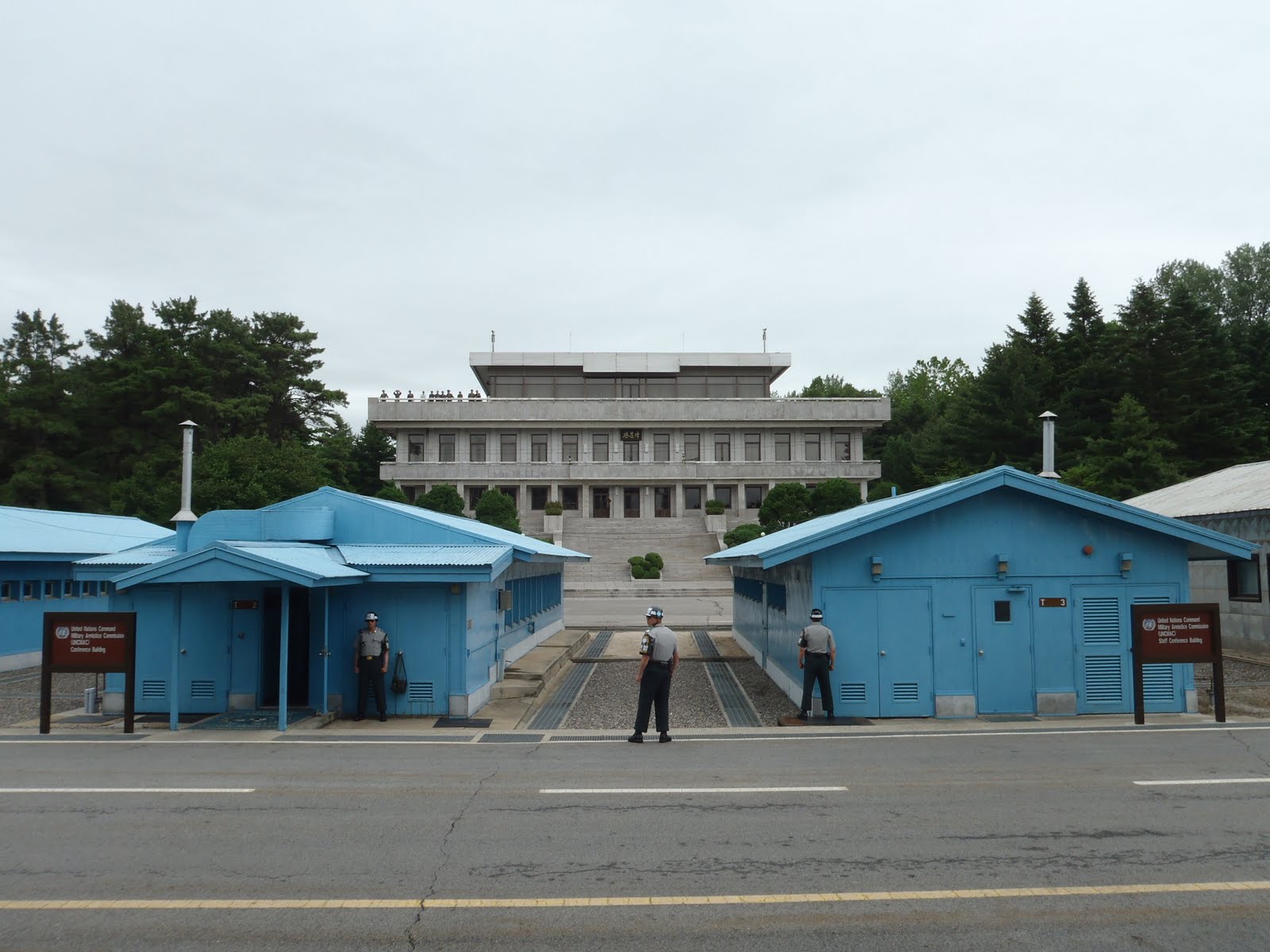
Once in Camp Bonifas we met our tour guide, an enlisted U.S. soldier at the camp, who would "debrief" us and give us our waivers to sign in case we got shot or whatever. From that point we watched a fairly uninspiring video on the history of the DMZ and the Korean War and we made our way to the Joint Security Area. The motto here and at Camp Bonifas is "In Front Of Them All." I finally understood what this meant when we got to the JSA. ROK Soldiers stand at a ready taekwondo pose literally facing the enemy every single day.
The gray building beyond is crawling with North Koreans. Notice the group on the top left balcony...

As we chose the 61st anniversary of the start of the Korean War to visit, we were rewarded by seeing a North Korean DMZ tour on the other side of the border. This, apparently, is not common. The blue building on the left is where the tour goes and certain inter-Korean talks are held.
See?

Inside, we were able to step into North Korea beyond this cement plank.
I have been to North Korea...but not really. I literally stepped about three feet into North Korea inside a secured building that was built by South Korea. Pretty lame, I know.

From there we went to a lookout where we got a solid glimpse of Kijong-dong, the North Korean "Propaganda Village" and home to the second tallest flagpole in the world.
The story of Propaganda Village is a rather involving one, but I'm here and you're here so let's get it over with. Part of the agreement (with God or whatever) is that each side could have one village in the DMZ. South Korea built Daesong-dong, a farm collective of 50 odd families with odd perks and restrictions. They are exempt from military service, pay no taxes, and the government will purchase 100% of their crop yield, thus earning them a salary of around $100K a year. The restrictions are that they have to spend 240 nights a year in the village, 11PM curfew, and men cannot marry into it.

North Korea, instead of investing in a farming village, decided to build a gigantic movie set. Kijong-dong is virtually uninhabited, yet someone turns on and off lights to make it seem inhabited. Upon closer inspection, it can be seen that the windows of buildings don't have glass and that most buildings don't even have interior rooms. Then there's the issue of the flagpole. Well, that's just a manhood issue between North and South and the South finally gave up. But the flagpole in Daesong-dong is pretty big too.

We next passed by the Bridge of No Return, named as such because after the Korean War, POWs were exchanged across this bridge with options: they got to choose North or South, but once they chose there was no going back... ...as well as the monument replacing the poplar tree from the Axe Murder Incident of 1976. The story behind that particular incident goes like this: South Korea had a lookout post next to the Bridge of No Return which was surrounded by North Korean lookout posts and blocked from South Korean view by a poplar tree.
Here's a visual aid for you folks of the lookout post in question. Keep in mind that North Korea surrounds this outpost on three sides. The Bridge of No Return is directly to the right of the blue outpost and the poplar tree would be blocking the view of the building if it were still standing.

So one day a dozen or so U.S. and ROK soldiers went over to cut it down (not carrying weapons [besides axes to cut down the tree] per the rules at the time). They were met by about 15 North Korean soldiers monitoring them. About 15 minutes into it, the North Koreans ordered them to stop the tree trimming and attacked, killing Bonifas with an axe and injuring others before escaping. North Korea's reasoning was that "Kim Il-Sung planted the tree personally and nourished it and it was growing under his supervision." The tree was at least 10 years older than Kim Il-Sung.

Then we hauled it over to the Third Tunnel. More North Korean craziness there. Do you see a trend? So, four man made tunnels have been discovered under the DMZ originating from the North. It is believed that there are more undiscovered ones. The idea is that North Korea would construct a series of tunnels leading to Seoul that would effectively transport troops and artillery underground in the case of an invasion. This particular tunnel could transport 30,000 troops per hour if completed. It was discovered prematurely, however, and the tunnel ends several kilometers shy of Seoul. When North Korea realized the South was aware of what they were doing, they covered the walls in black. "Why did they do that, Steve?" Well, their subsequent explanation for the tunnel was that it was a coal mine. Yeah, pretty lame considering it's in limestone rock with no coal anywhere in the area. Anyway, the tunnel was...a tunnel. It was surprisingly deep though, at about 400 meters underground (for those dastardly Americans, that's about a quarter of a mile).

Here is also where the gift shop was, so I purchased a rare treat (and probably the only interesting, unique thing in there):
"Chiggity check yo-self."

North Korean beer. It was actually better than South Korean beer because apparently Kim Jong-il imported, brick by brick, a brewery from England to create his own beer.

Our final stop was Dorasan Station. This train station was built in the hopes of reunification. It's an unused train station with two significant points of interest: first, it is the northern most train station in South Korea and second, it has tracks going to Pyeongyang. If this reunification were ever to be realized, this train station would be one of a long, long line of train stations running from Busan, Korea to Lisbon, Portugal. Yes, it would be the longest train line in the world. North Korea is literally standing in the way of that...
"None shall pass!"

The DMZ tour offered through the USO is definitely a worthwhile experience for those visiting Korea or living here. Even to those living here, it is a bizarre look into the sensitive relationship between the North and South.

Sunday, June 19, 2011

Gangwon-do Adventures

Gangwon-do in Korea is the most rural, rugged, and most mountainous of South Korea's nine main -dos. Highlights of Gangwon-do include: Seoraksan National Park, mainland South Korea's tallest mountain; Pyeongchang, South Korea's 2018 Winter Olympic bid; and the home of Dokdo, the contested islets off the coast. Here's it's location in relation to Daegu:
It's the pink one, guys.

This past weekend, I took the trip up to Daejeon to meet my roommate from orientation who I hadn't seen in over a year. Since last I saw him, he had upgraded to a university job as well as gotten a car. This latter fact enabled us to explore the otherwise mysterious Gangwon-do in ways that is difficult without a jalopy in which to do it. Indeed, I had never been to Gangwon-do before this past weekend.

ROAD TRIP!!!! That's right. We took a several hour road trip to the East coast. You may not think it would take this long, but it took four hours to get to the East coast. Yeah, it's that mountainous over there. However, it is also beautiful. On our way we passed aforementioned Pyeongchang, the Winter Olympic hopeful. Upon seeing it, I could only think how much infrastructure they would have to invest in to make it Olympic worthy. It can't have a population of more than 20,000. Nonetheless, it had a sleepy Alpine feel to it as we passed. I can only imagine that that infrastructure would drown out the quaint sleepiness of it and actually put it on the map. It could even ruin Gangwon-do. Or...they'll host most of it in neighboring Gyeonggi-do where all of Seoul's influence lies and have only the skiing part in Pyeongchang. Who knows?

As we snaked down the coast admiring rolling mountains that spilled into the ocean, we came upon our first destination: The Reunification Park. This is, of course, referred to Korean reunification. It was fairly dinky with a few Korean War planes and...South Korean Air Force One from the 60s. As you were allowed inside, we got to see where da prezident once sat.

What was more alluring about the park was that down the road there were three naval displays. The first was a Korean war ship that was built by the U.S. in 1945 and then donated to South Korea in the 60s.
"Did you get your tickets?" "What tickets?" "To the gun show!"

Granted, it wasn't as exciting as the U.S.S. Missouri, but it was still kind of neat. Second, we had the small dinghy that the 2009 North Korean defectors used to paddle their way across the border.
How'd you like to live on that for a couple of days?

The last was easily the most alluring. A North Korean submarine. A real one. So, turns out in 1996, a North Korean submarine shored up on Gangwon-do to release some spies to do some spying and hopefully assassinate some VIPs attending some function in the area. On the way out (assassination mission failed), their submarine got stuck on some rocks, so the 13 agents abandoned ship after shooting the submarine crew and burning all their documents. 12 agents were subsequently killed in a firefight and one was captured alive, giving us the information we have. The submarine was subsequently made into a little museum to North Korean aggression.
The results of two starkly contrasting economic systems in one picture.

The inside of the submersible actually wasn't that exciting, but it was still worth it to see (and you had to wear a hard hat to go inside because it's as treacherous as the North Korean regime!).

We snaked down the coast some more, still taking in those rolling mountains that spilled into the ocean, and eventually came upon a landmark sight. In a sleepy beach town there lies this:
A cruise ship on a hill. "Why is there a cruise ship on a hill?" you may ask. Nobody fucking knows. I'm just kidding. It's a hotel that was built into the shape of a cruise ship. From what I hear, it's actually a pretty nice hotel (not surprisingly). The only problem is, what else is there to see in this town? Well, there is a nice beach and the added bonus of our next destination: Haesindang Park.

Haesindang Park was created under the belief that it would satisfy the spirit of a young woman who drowned in the area. After she drowned, the amount of seafood gathered in the area plummeted, so they built a park to satisfy her. Since then, the seafood yield returned to normal. This is no normal park, although it has wonderful rocky beaches. No, this park is full of giant, erect penis statues.
Not pictured: the giant, erect penis statues.

It seems Korea has an obsession with genitalia between this park and Loveland on Jeju-do. What could it be? Probably a vein attempt at getting their birth numbers back up. Either way, it makes a pretty bizarre, yet entertaining adventure for the occasional Westerner who passes through.

That night we stayed in Samcheok, in the southern part of Gangwan-do. They have some sort of specialization in seafood, so we tried blisteringly spicy grilled eel that was actually not bad despite its blistering level of spice.

The morning consisted of the mostly uneventful drive back. All in all, one of the more eventful weekends I've had in a while.

Tuesday, June 14, 2011

Moon Me

There was a period of time that I didn't even want to acknowledge this blog existed. It was that shameful to me. Neglecting it for so long. But, something has spurred me back. The tiniest little thing. There are those of you who may fault my reasons to slink back to the keyboard, but nobody gives a crap about your negative feelings anyway. What brought me back was to write a movie review (ewww...).

Before I get into it though, I wanted to let you know that I have no less than three draft posts in my que just waiting to be finished. I had attempted three times to update since May 20th and failed miserably at each one. What did it take for me to get back? A friggin' movie. Not any of your whiney pleas for me to start writing again. Not boredom, not guilt. A movie. It must be pretty good, right? Well, let's just say that it hit a chord with me.

Moon (2009) is a sci-fi flick that somewhat pays homage to the classics (2001: A Space Odyssey, Solaris, and that one George Lucas film he did before Star Wars). Sam Rockwell plays Sam Bell, the solitary contract worker on the moon harvesting Helium-3, the clean energy of the future. His only company is Gerty, a computer voiced by Kevin Spacey. As his three year contract finishes up, Sam starts experiencing strange things and hallucinations. That's about all I knew about the film when I started watching and I really can't say much more without giving up what made it so intriguing a watch.


Moon is the writing and directorial debut of Duncan Jones, David Bowie's first son. After watching it, I can attest that Jones is a solid writer/director. I feel like he must have been an English teacher in Korea by the way I can relate to this movie. The solitude one can sometimes feel living in a foreign country, the silly projects one undertakes whilst within that solitude, the longing to see people, the monotony of a job. All things I can very well relate to. Also there are other strange coincidences that give it another level for me. The base on which Sam lives is called "Sarang." Sarang is Korean for "love" and even the hangeul is written on the base: 사랑. There you go, I helped you with a metaphor.


There are layers to this movie that you only catch by watching and paying attention. First there is the slightly humorous alarm tune that wakes Sam up every morning. Also, it is never suggested, but it can be implied that Korea in the future has a much more global role (and even lunar, asitwere). This is demonstrated by both the name of the base as well as some dialogue. At a pivotal point in the movie, a recording says, "annyeonghi kyeseyo (안녕히 계세요). Goodbye." This in Korean means "stay well," as in "you are staying here. Stay here well while I leave." According to the situation, the recording should have said "annyeonghi kaseyo (안녕히 가세요). Goodbye." This would translate to "go well." However, the fact that they used "stay well" instead of "go well" is pivotal to what happens next and you'd only catch the intention if you knew those Korean phrases. Of course, you still get it eventually without knowing. I love little things like that in movies. It shows attention to detail and foresight that most of your viewers will miss it.


Sam Rockwell definitely expanded his acting chops in this movie, portraying practically the only character we see onscreen. And, despite being a bucket of bolts, Kevin Spacey's Gerty is surprisingly warm and dynamic. All in all, a really well done film that I'd suggest to fans of science fiction. One of them thinkers about the definition of life and all that.


The Hardest Goodbyes

I had to post twice in a day. It's my final day in Korea and there are so many emotions running through ma veins, through ma brains. I u...